



Architects and developers are increasingly specifying large format limestone tiles for contemporary buildings, but the attraction is not simply a larger visual grid. A thin joint can make a lobby appear calmer, while a poorly selected stone can lead to staining, lippage, cracking, or expensive replacement. Buyers comparing a China Limestone Tiles Supplier should therefore assess sustainable limestone tile cladding, limestone facade panels, water absorption, flexural strength, and slip resistance before approving a sample. In a hotel entrance, retail atrium, or high-end residence, the successful solution is a coordinated system—from quarry selection and slab processing to substrate preparation, installation, sealing, and maintenance.
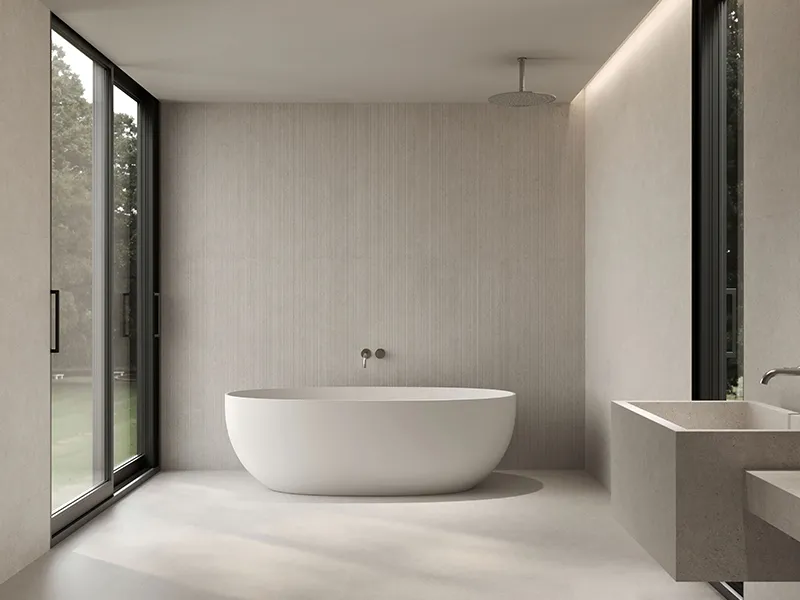
Why Contemporary Buildings Are Moving Toward Large-Format Limestone
Contemporary architecture often favors fewer visual interruptions, natural textures, and materials that connect interior and exterior spaces. Large limestone panels support that direction because fewer joints can produce a more continuous floor, wall, or rainscreen appearance. The material also offers variation that manufactured surfaces may imitate but cannot reproduce exactly: fossil markings, sediment lines, open pores, and subtle changes in background color.
However, “large format” is not a guarantee of performance. A 1,200 × 2,400 mm panel has a surface area of 2.88 m² and is more sensitive to handling, support, flatness, and thermal movement than a small tile. The larger the panel, the more important it becomes to verify actual production tolerances, thickness, edge condition, moisture behavior, and the compatibility of adhesives or mechanical anchors.
China Limestone Tiles Supplier Selection Is Becoming More Technical
A professional China Limestone Tiles Supplier should provide more than color photographs. A serious technical package normally includes the quarry or block source, nominal and actual thickness, dimensional tolerances, finish description, test reports, batch information, installation recommendations, and a sample approval process.
For natural stone, test methods matter. ASTM C97 covers absorption and bulk specific gravity testing for dimension stone; ASTM C99 addresses modulus of rupture; and ASTM C170 addresses compressive strength. These standards do not make every limestone suitable for every application, but they establish a more reliable basis for comparison than terms such as “premium,” “strong,” or “high quality.” The Natural Stone Institute also emphasizes that stone performance depends on the specific material and application rather than on the word “limestone” alone.
Key Drivers Behind Large-Format Limestone Tile Innovation
Large-Format Limestone Tiles for Contemporary Buildings and Visual Continuity
Large panels answer a recognizable design problem: repeated grout lines can interrupt expansive floors, elevator surrounds, reception desks, and feature walls. Designers can use book-matched or vein-matched layouts to make a wall read as a single composition. The result is especially effective in spaces with long sightlines, indirect lighting, and restrained furniture.
The visual benefit must be balanced against movement joints and constructability. A specification should identify maximum panel dimensions, joint width, movement-joint locations, corner details, and acceptable shade variation. Eliminating visible joints entirely is not a sound installation objective; joints are part of the system that accommodates construction tolerances and movement.
China Limestone Tiles Supplier Innovation in Thin Panels and Reinforced Systems
Some suppliers now offer reduced-thickness panels, resin-filled surfaces, fiberglass backing, or honeycomb-backed stone systems. These products can reduce dead load and make large wall panels easier to handle, but the backing changes the product from a simple stone tile into a composite system. The purchaser should request fire classification, bond durability, water exposure limits, panel flatness, edge treatment, and repair procedures.
Thin limestone should not be selected solely because it weighs less. A façade engineer must confirm wind-load resistance, anchor capacity, differential movement, seismic requirements where applicable, and the behavior of the complete assembly. For interior floors, the installer must confirm that the selected thickness and support conditions can resist expected concentrated loads.
Sustainable Limestone Tile Cladding and Documented Environmental Data
Sustainability claims are becoming more evidence-based. An Environmental Product Declaration, or EPD, reports environmental impacts using a defined product category rule and life-cycle assessment. ISO 14025 provides principles for Type III environmental declarations, while EN 15804 is widely used for construction-product EPDs in Europe. An EPD does not automatically mean that one limestone product is environmentally superior; transport distance, extraction method, processing energy, packaging, service life, and replacement frequency can materially change the result.
Natural stone can support material-efficiency goals when it is used for a long service life and cut planning reduces waste. A project team should ask for quarry-specific or product-specific documentation rather than accepting an unverified statement such as “zero carbon” or “eco-friendly.” Reclaimed stone, local fabrication, reusable packing, and nesting layouts may reduce waste, but each claim should be measured through project records or an applicable environmental declaration.
Four Emerging Large-Format Limestone Tile Trends
1. China Limestone Tiles Supplier Products With Honed, Brushed, and Soft-Matte Finishes
Polished stone remains appropriate for selected feature areas, but contemporary projects increasingly use honed, brushed, sandblasted, or lightly textured finishes. These surfaces reduce mirror-like reflections and make the stone feel more architectural. A honed finish can also make minor scratches less conspicuous than a high-polish surface, although it does not make limestone scratch-proof.
Finish selection should be tied to use. For a public floor, request a slip-resistance test using the standard required by the project jurisdiction. In Europe, manufacturers may reference classifications under DIN EN 16165 or related national procedures; in North America, project teams may use methods such as ANSI A326.3 for hard-surface flooring. Test values are meaningful only when the test method, wet or dry condition, footwear condition, and product finish are stated.
2. Large-Format Limestone Wall Panels With Warm Neutral Color Families
Beige, ivory, sand, and pale gray limestone are being paired with dark metal, natural oak, concrete, and colored glass. The trend is less about a single fashionable color and more about creating a neutral background with natural depth. Designers frequently request a controlled range rather than a perfectly uniform field.
A proper color-control procedure should include a dry-laid mock-up with several crates or slabs, photographed under the intended lighting. The approval should define acceptable variation in background tone, veining, open pores, fossil marks, filled areas, and edge shade. One 300 × 300 mm sample cannot represent a 2.88 m² panel or a 200 m² installation.
3. Sustainable Limestone Tile Cladding With Modular Panel Sizes
Although oversized panels attract attention, modular large-format sizes are often easier to transport, replace, and coordinate with doors, columns, and service access. Common project discussions include 600 × 1,200 mm, 750 × 1,500 mm, and custom slab formats, but the best size depends on quarry block yield, loading limits, lift dimensions, layout, and substrate geometry.
Computerized nesting can improve yield by positioning cut pieces around openings and using compatible offcuts for skirtings, vanity tops, or smaller wall zones. The project should record the purchased area, installed area, cut-off area, and breakage area. That information provides a more credible waste assessment than a general claim that large-format stone is “low waste.”
4. Limestone Facade Panels Combined With Concealed or Hybrid Fixings
On ventilated façades, limestone is increasingly used as part of a drained and ventilated cladding assembly rather than as a thin decorative layer bonded directly to an unverified substrate. Concealed kerfs, undercut anchors, rails, and hybrid adhesive-mechanical systems may be considered, but the correct solution depends on panel thickness, stone strength, panel dimensions, wind pressure, building movement, fire strategy, and local code.
For a façade, the design team should request engineering calculations and physical testing where required. The stone itself is only one component. Anchors, brackets, rails, seals, insulation, cavity barriers, fixings, and the supporting wall must work as a tested or properly engineered system.
What These Trends Mean for Buyers
China Limestone Tiles Supplier Risk: Appearance Is Not the Same as Performance
Two stones may look similar in a showroom but behave differently under water, freeze-thaw cycles, acidic cleaning products, or repeated foot traffic. Limestone is generally calcium-carbonate based and can react with acidic substances. Lemon juice, vinegar, acidic descalers, and some cement-removal products may etch or dull susceptible finishes. A maintenance specification should identify approved cleaners, dilution ratios, dwell time, rinsing requirements, and stain-response procedures.
For wet rooms, pool surrounds, kitchens, entrances, and exterior applications, ask for water absorption and relevant durability data from the actual stone. If freeze-thaw exposure is possible, request a test appropriate to the climate and intended use. A generic statement that the stone is “weather resistant” is not sufficient evidence.
Large-Format Limestone Tiles for Contemporary Buildings Increase Installation Demands
Large panels expose substrate problems that small tiles may partially disguise. Before installation, the contractor should verify floor or wall flatness against the applicable tile and stone standard, remove dust and weak surface material, confirm moisture conditions, and plan a lifting route. Mechanical lifting equipment, suction systems rated for the panel weight, edge protection, and trained handlers may be necessary.
For floors, the installer should use a mortar or adhesive system approved for the stone and format, achieve the specified coverage, and avoid voids beneath areas exposed to point loads. Back-buttering may be required by the installation method. For walls, the substrate, adhesive, temporary support, and movement joints should be reviewed by the responsible installer or engineer rather than copied from a small-tile detail.
Practical Specification Process for a China Limestone Tiles Supplier
Step 1: Define the Application Before Choosing the Stone
- Separate interior walls, interior floors, wet areas, stairs, countertops, ventilated façades, and direct-bond exterior walls.
- Record traffic level, expected wheeled loads, impact risk, cleaning chemicals, freeze-thaw exposure, sunlight, and proximity to food or water.
- State the target panel size, nominal thickness, finish, edge profile, joint width, and acceptable shade range.
- Identify local requirements for fire performance, slip resistance, accessibility, façade retention, and seismic movement.
Step 2: Compare Verified Technical Data
Request a current technical data sheet and test reports for the same quarry, finish, and thickness being quoted. Review water absorption, bulk density, flexural or rupture strength, compressive strength where relevant, abrasion behavior for floors, freeze-thaw performance for exposed applications, and slip-resistance results for walking surfaces. ASTM, EN, or national standards should be named on each report so the results are not compared across incompatible methods.
Check whether the report identifies a laboratory, test date, sample description, conditioning procedure, and result units. A report for a 20 mm honed sample may not represent a 30 mm brushed sample with resin filling. When project risk is high, arrange independent testing of a production sample rather than relying only on a marketing sample.
Step 3: Approve a Full-Scale Mock-Up
The mock-up should include the intended substrate, adhesive or fixing system, grout, sealant, edge details, lighting, and cleaning method. For a large wall, use enough stone to show natural variation. Approve not only the color but also joint alignment, lippage, corner appearance, filled pores, vein direction, and the visual effect after sealing.
Step 4: Control Production, Packing, and Delivery
Agree on slab or tile numbering, crate labeling, moisture protection, corner guards, pallet limits, and replacement procedures before production begins. Large panels are vulnerable to edge damage during loading and unloading. The delivery plan should confirm container height, site storage, lift access, weather protection, and the sequence in which crates will be opened.
Keep an approved reference panel and batch photographs. If the project uses vein matching, the supplier should provide a layout map showing the intended sequence. Casaferra can be evaluated through the same transparent process: visual approval, technical documentation, production inspection, and installation coordination should be treated as one supply-chain task rather than separate conversations.
Step 5: Plan Sealing and Maintenance From the Start
Sealing does not make limestone impermeable and does not prevent all staining. It can reduce the rate at which some liquids penetrate, but performance depends on the stone's porosity, product chemistry, application rate, curing conditions, and maintenance. The installer should perform a small-area test, document the product, and follow the manufacturer's stated coverage and curing time.
Maintenance should use pH-neutral stone cleaner unless the stone-care manufacturer approves another product. Dust and grit should be removed regularly because abrasive particles can contribute to surface wear. Spill response should be immediate, especially for coffee, wine, oil, colored cosmetics, and rust-producing materials. Periodic resealing should be based on a water-drop or stain-performance check and the product manufacturer's guidance—not an automatic calendar promise.
Common Purchasing Mistakes to Avoid
- Choosing from one small sample: a small sample cannot show full-scale color variation, vein direction, or panel flatness.
- Using interior tile data for an exterior façade: façade loads and environmental exposure require a separate engineering review.
- Specifying “slip-resistant” without a test method: request the measured result, test standard, and wet or dry condition.
- Assuming a sealer solves chemical sensitivity: limestone can still etch when exposed to acids.
- Ignoring substrate tolerances: oversized panels need a flatter, cleaner, and better-supported installation surface.
- Comparing prices by square meter alone: include thickness, finish, edge work, crates, breakage allowance, freight, lifting, installation, sealing, and expected replacement cost.
- Accepting undocumented sustainability claims: request an EPD, quarry information, recycled-content evidence, or a measured waste record where such claims affect the project decision.
Final Outlook for Large-Format Limestone
Large-format limestone is moving from a decorative upgrade to a coordinated building-system decision. The strongest projects use natural variation deliberately, select panel dimensions that suit transport and installation, document performance with recognized test methods, and protect the material through compatible detailing and maintenance. For buyers, the best China Limestone Tiles Supplier is not necessarily the one offering the lowest initial quotation; it is the one that can connect quarry consistency, measurable technical data, production control, packaging, engineering support, and after-sales guidance. When those steps are completed, large format limestone tiles for contemporary buildings can deliver a durable visual language while sustainable limestone tile cladding and carefully tested limestone facade panels support responsible long-term specification.


