



Small rooms often look busy when they are covered with many short tile joints, while genuine limestone can bring sealing, staining, and shade-variation concerns. The 600×1200 limestone tile format offers a practical middle ground: it creates a calmer surface with approximately 1.39 tiles per square metre and fewer grout lines than standard 300×600 mm pieces. This review focuses on 600x1200 limestone tiles for bathroom walls, the best limestone-look tiles for modern kitchens, and how to evaluate a China Limestone Tiles Supplier. It also explains natural stone look, large-format tile installation, porcelain limestone effect, water absorption, coefficient of friction, and rectified edge quality.
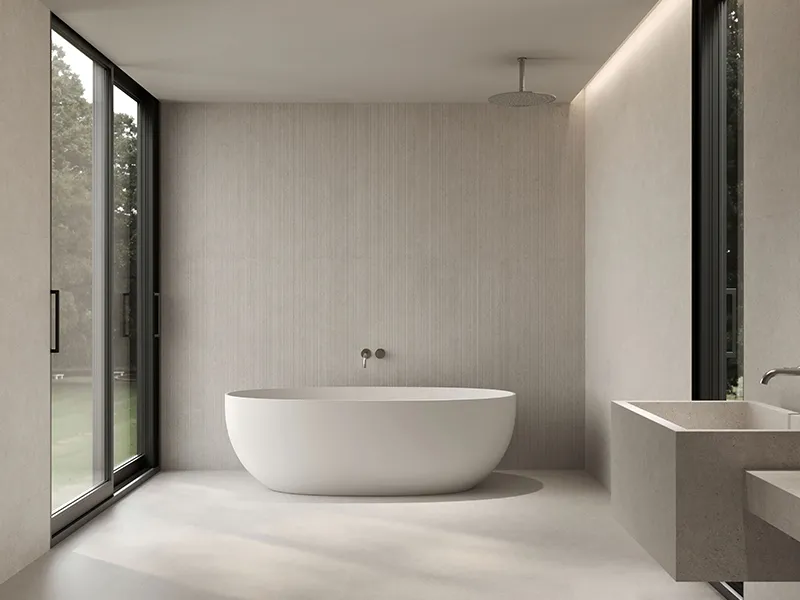
600×1200 Limestone Tiles from a China Limestone Tiles Supplier: Product Overview
A 600×1200 mm tile measures 600 mm by 1,200 mm, or 0.72 square metres per piece. In theory, 100 square metres requires about 139 tiles before adding waste. In practice, a straight-lay installation normally needs around 5% to 10% extra material, while diagonal layouts, herringbone details, complicated room shapes, and high-cut projects may require more.
The format is usually sold in one of two forms:
- Porcelain limestone-effect tile: manufactured from refined mineral materials and fired at high temperature. It imitates the colour, pores, and sedimentary movement of limestone while generally requiring less routine sealing.
- Natural limestone tile: cut from quarried stone. Each piece may show genuine fossil marks, open pores, bedding lines, and shade differences. It normally requires a compatible sealer and more careful cleaning.
These two products should not be judged by the same standard. A porcelain tile may be easier to maintain in a shower, entrance, or kitchen, whereas natural limestone may be selected for its authentic tactile variation. Product descriptions should clearly state the material, thickness, finish, edge type, water absorption, slip classification, and recommended application.
Who Benefits from 600×1200 Limestone Tiles?
- Bathroom renovators: the longer tile can make a narrow wall appear more continuous and reduces the number of horizontal grout joints.
- Kitchen designers: limestone colouring works with timber, brushed metal, white cabinetry, and warm grey joinery without the high contrast of patterned marble.
- Hospitality and retail projects: consistent batch production and simplified cleaning can be more useful than the irregularity of hand-selected natural stone.
- Homeowners seeking a quiet interior: a low-contrast limestone pattern is less visually demanding than strong veining.
The format is not automatically suitable for every room. A 600×1200 tile is heavy and less forgiving of uneven walls than a small tile. It may also be difficult to carry through narrow staircases or position around niches, floor wastes, window reveals, and plumbing penetrations.
600×1200 Limestone Tiles from Casaferra: Unboxing and Inspection Process
A fair review should begin before installation. The following inspection sequence can be used when receiving Casaferra tiles or samples from another manufacturer. It avoids confusing a visually attractive sample with a complete, installation-ready product.
China Limestone Tiles Supplier Packaging Check
- Check the carton label. Confirm the product name, colour, batch number, size, thickness, quantity, finish, and intended application. Tiles from different batches may have noticeable shade differences.
- Count the coverage. A 600×1200 mm tile covers 0.72 square metres. Compare the printed coverage with the number of pieces supplied rather than relying only on the carton count.
- Inspect corners and edges. Look for impact chips, hairline cracks, edge bruising, and broken protective separators. Photograph damage before signing for delivery.
- Mix tiles from several boxes. Lay at least six to ten pieces on a clean floor. This reveals whether the pattern repeats too obviously or whether one box is materially darker.
- Check the back surface. Dust, powder, oil, or excessive release residue can reduce adhesive contact. The back should be clean enough for the specified adhesive system.
- Measure several tiles. Use a steel rule or caliper to check length, width, and thickness at different points. Small dimensional differences become more visible with a narrow grout joint.
Casaferra 600×1200 Limestone Tile Visual Test
Place the tiles under the lighting used in the finished room. Warm 2700–3000 K lighting can make beige limestone look more yellow, while cool 4000 K lighting can emphasise grey undertones. View the sample both wet and dry if it will be used near water. A wet surface often appears darker, and that change is especially important for honed natural limestone.
For a natural-stone product, examine open pores, resin-filled areas, fossils, veins, and bedding lines. These are not necessarily defects, but they affect cleaning and the final appearance. For a porcelain limestone-effect tile, inspect print resolution, edge shading, repeat frequency, and whether the surface texture aligns with the printed pattern.
Performance Review of 600×1200 Limestone Tiles
Water Absorption and Moisture Performance
Water absorption is one of the most useful technical measurements. It is the percentage of water absorbed by a dry tile under a defined test method. Lower absorption generally indicates a denser tile, but the correct classification depends on the applicable standard and product type.
Porcelain tiles are commonly associated with water absorption of 0.5% or less under the relevant ceramic-tile classification system. That figure should be confirmed on the manufacturer’s test report rather than assumed from the word “porcelain.” Natural limestone varies substantially because it is a geological material with different porosity levels. A limestone tile may need sealing even when it looks dense and smooth.
For shower walls, the tile itself is only one part of moisture protection. The substrate, waterproofing membrane, movement joints, adhesive, grout, and penetrations around taps must also be correctly installed. A low-absorption tile cannot compensate for a poorly waterproofed wall.
Surface Safety and Coefficient of Friction
For floors, ask for a slip-resistance result appropriate to the intended environment. “Non-slip” is not a complete technical specification. The coefficient of friction, ramp classification, or other regional test result should identify whether the finish is intended for dry interiors, wet areas, barefoot use, or commercial traffic.
Polished or highly glossy limestone-effect surfaces may be unsuitable for a frequently wet floor even if they perform well on a wall. Honed, structured, or matte finishes are usually easier to specify for wet walking surfaces, but rougher textures can collect soap residue and require more frequent cleaning.
Strength, Chipping, and Large-Format Handling
Large tiles do not automatically have higher impact resistance. Their performance depends on body composition, thickness, support, handling, and installation. A tile with a void beneath it can crack under point loading even if the tile passed a laboratory strength test.
The main practical risk is handling damage. Two people may be sufficient for some tiles, but a panel lifter or additional installers may be safer depending on thickness and weight. Do not estimate weight without the technical sheet: a 600×1200 mm tile at 9 mm thickness has a volume of 0.00648 cubic metres, but the final weight depends on density and whether it is ceramic, porcelain, or natural stone.
Rectified Edges and Grout-Joint Control
Rectified edges are mechanically finished after firing to improve dimensional consistency. They allow a cleaner, more controlled joint, but they do not justify a zero-joint installation. The minimum joint must follow the manufacturer’s tolerance, local practice, and substrate conditions.
A narrow grout joint makes wall irregularities more noticeable. Before installation, the installer should check the wall with a straightedge, correct uneven areas, establish a level starting line, and plan cuts around visible features. A 50% brick pattern is not always suitable for large-format tiles because tile curvature can create lippage; the adhesive manufacturer may recommend a maximum offset or a different layout.
Where 600×1200 Limestone Tiles Work Best
600×1200 Limestone Tiles for Bathroom Walls
This is one of the strongest applications for the format. The tile can run vertically to increase the perceived height of a shower wall or horizontally to emphasise its width. Fewer joints also mean fewer grout lines to scrub, although the grout itself still needs suitable cleaning and maintenance.
Use porcelain limestone-effect tiles where low absorption, repeatable colour, and reduced sealing work are priorities. Use natural limestone only when the owner accepts periodic sealing, colour variation, and a more sensitive response to acidic products such as vinegar, lemon juice, and some bathroom cleaners.
Best Limestone-Look Tiles for Modern Kitchens
On kitchen walls, the format creates a broad, calm backdrop behind cabinetry and open shelving. A matte beige or greige finish can hide minor splashes better than a dark polished surface, but textured surfaces may retain grease. Near a hob, select a finish that can be cleaned without abrasive scrubbing and confirm that the grout and sealant are appropriate for heat and food-preparation areas.
For kitchen floors, review slip performance, stain resistance, abrasion classification, and cleaning instructions separately. A wall tile is not automatically suitable for flooring. Ask the China Limestone Tiles Supplier for the application category in writing.
Large-Format Limestone Tile for Living Areas and Commercial Interiors
Living rooms, hotel corridors, reception areas, and retail walls can benefit from the reduced visual rhythm of 600×1200 mm modules. The format also coordinates well with 600×600 mm or 300×600 mm companion sizes when a project requires borders, niches, or transition zones.
For floors, the slab support and subfloor flatness become more important than the appearance of the sample. A floor with significant deflection, cracked screed, or poorly positioned movement joints is a poor candidate for large-format tile without remedial work.
Installation Problems to Solve Before Buying 600×1200 Limestone Tiles
Wall Flatness and Adhesive Coverage
Large-format installation requires a flatter substrate than small-format installation. The exact tolerance should come from the tile and adhesive manufacturers or local standard. The installer should use a compatible cementitious or reaction-resin adhesive, comb the adhesive in one direction, and use back-buttering where specified.
After placing a tile, lift an occasional piece to verify coverage. Voids behind a large tile increase the risk of cracking, movement, and hollow spots. The goal is not simply to press the tile until it looks level; it is to achieve the coverage required for the application, particularly in wet areas and high-traffic floors.
Cutting, Drilling, and Waste
Large porcelain tiles should be cut with equipment suitable for their thickness and finish. Natural limestone may cut more easily but can chip or crumble around weak veins and open pores. Use a diamond blade, support the tile close to the cut, and make plumbing penetrations with the correct diamond hole saw.
Allow at least 5% to 10% spare material for a straightforward installation. Retain several unused tiles after completion for future repairs because a later replacement may not match the original batch.
Cleaning and Long-Term Maintenance
Porcelain limestone-effect tiles normally need pH-neutral cleaning and prompt removal of cement haze after installation. Natural limestone should not be cleaned with acidic descalers, vinegar, lemon-based products, or harsh bathroom chemicals unless the stone-care manufacturer specifically approves them.
Sealing does not make natural limestone stain-proof. It generally slows absorption and gives the owner more time to wipe spills. The re-sealing interval depends on porosity, traffic, product type, and cleaning routine; a fixed “every year” claim is unreliable without a site test. Test water or an approved sealer sample in an inconspicuous area and follow the sealer manufacturer’s instructions.
600×1200 Limestone Tiles Compared with Competing Options
| Material | Main advantage | Main limitation | Best use |
|---|---|---|---|
| Porcelain limestone-effect tile | Consistent production, low maintenance, broad application range | Printed pattern may repeat; quality varies by manufacturer | Bathrooms, kitchens, commercial walls, many interior floors |
| Natural limestone | Authentic mineral variation and tactile depth | Porosity, sealing, acid sensitivity, and batch variation | Feature walls, carefully maintained bathrooms, premium interiors |
| Marble-look porcelain | Strong veining and a more decorative appearance | Can dominate a small room; polished versions may be slippery | Feature areas and high-contrast interiors |
| Concrete-look porcelain | Modern industrial character and usually simple maintenance | May feel colder or more utilitarian than limestone colouring | Contemporary kitchens, offices, and open-plan spaces |
| Small-format ceramic tile | Easier positioning on uneven surfaces and around complex details | More grout joints and a busier visual field | Curved walls, small niches, compact bathrooms |
How to Compare Casaferra with Other China Limestone Tiles Suppliers
Do not compare only catalogue photographs. Request a physical sample, technical datasheet, batch information, installation guidance, care instructions, and an actual test report where relevant. Compare:
- Declared water absorption and applicable product classification.
- Thickness tolerance, warpage, and shade consistency.
- Surface finish and slip-resistance data for floor applications.
- Availability of matching sizes, trims, mosaics, and replacement stock.
- Packaging quality and the supplier’s process for handling transit damage.
- Whether the image is a real installed product or a digitally enhanced render.
Casaferra is worth shortlisting when its physical sample matches the project’s required colour, texture, edge quality, and technical classification. The brand should still be assessed against the same documentation requirements as any other manufacturer. A polished sales image cannot replace a technical sheet or a sample viewed under the project’s lighting.
600×1200 Limestone Tile Ratings and Buying Suggestions
| Category | Rating | Reason |
|---|---|---|
| Visual continuity | 4.5/5 | Fewer joints produce a calm, architectural surface when the substrate is flat. |
| Bathroom wall suitability | 4.5/5 for porcelain; 3.5/5 for natural limestone | Porcelain generally reduces moisture and sealing concerns; natural stone needs more care. |
| Installation ease | 3.5/5 | Fewer pieces can speed layout, but handling, lifting, cutting, and wall preparation are more demanding. |
| Maintenance | 4.5/5 for porcelain; 3/5 for natural limestone | Porcelain is usually simpler to clean, while limestone is acid-sensitive and porous. |
| Design flexibility | 4/5 | Works with warm timber, neutral cabinetry, metal finishes, and both contemporary and classic schemes. |
| Value for money | 4/5 | Reduced grout area and durable finishes can justify the cost, provided installation is properly planned. |
Choose 600×1200 limestone-effect porcelain when the priority is predictable maintenance, consistent colour, and use in wet or busy areas. Choose genuine limestone when the owner values geological variation and accepts sealing, careful cleaning, and possible shade changes. Avoid the format on badly uneven walls, fragile substrates, narrow access routes, or projects where the installer cannot safely handle large pieces.
Before placing an order, obtain a physical sample from a China limestone tiles supplier, confirm 600x1200 limestone tiles for bathroom walls suitability, and compare the best limestone-look tiles for modern kitchens by data rather than photographs. Check water absorption, coefficient of friction, rectified edge tolerance, batch consistency, and cleaning requirements. For buyers considering Casaferra, that checklist provides a balanced way to judge the brand’s natural stone look, large-format tile quality, and porcelain limestone effect without treating marketing adjectives as performance evidence.


